Ketchup Is a Monopoly and Mustard Is Anarchy: A Condiment Game Theory
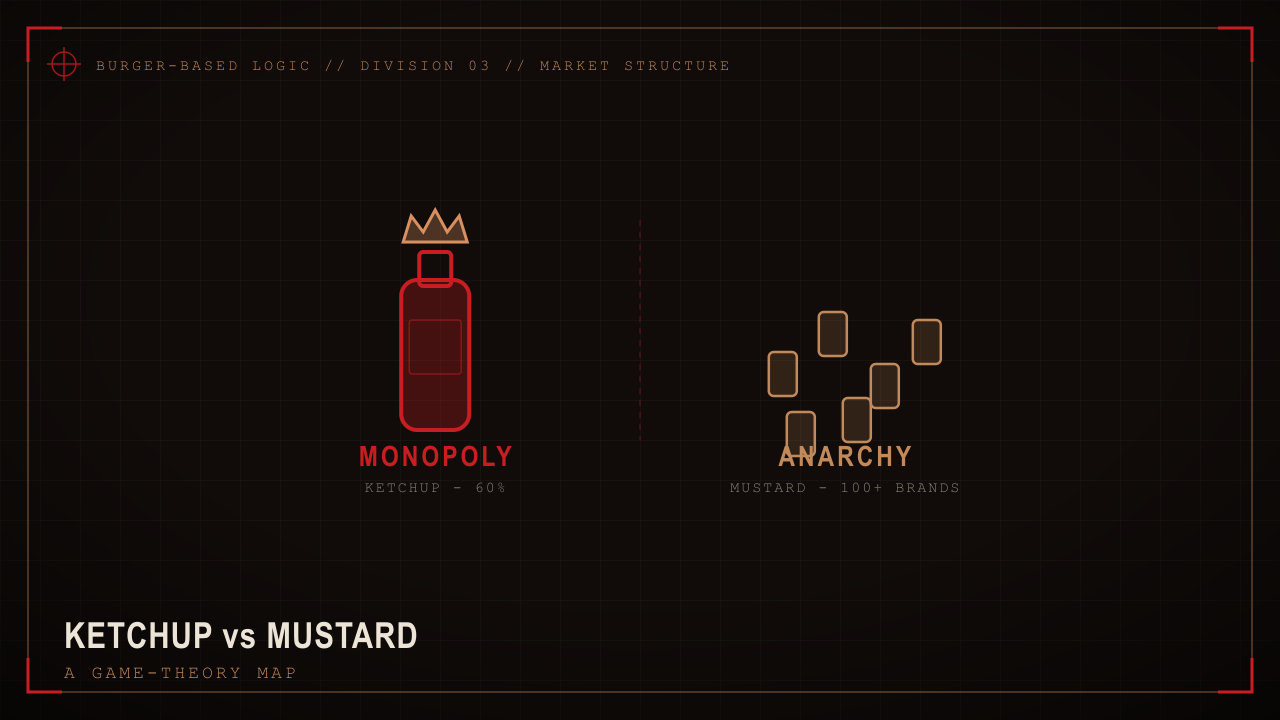
Heinz controls 60% of the American ketchup market. Mustard exists in over 100 varieties with no dominant player. This is not a coincidence. Ketchup is a monopoly. Mustard is anarchic. And the reason tells you something important about how markets actually work.
Heinz controls roughly 60% of the American ketchup market. In the United Kingdom, the figure climbs closer to 80%. Ketchup, as a product category, is dominated by a single brand to a degree that would trigger antitrust lawyers in almost any other industry. Meanwhile, walk three feet over to the mustard aisle and you find chaos: French's, Grey Poupon, Gulden's, Maille, Colman's, Plochman's, dozens of regional brands, hundreds of artisanal jars. No single mustard maker commands more than a sliver of the whole.
Two condiments. Same aisle. Same shoppers. Same sandwiches. One is a monopoly, the other is an anarchist collective. This is not random. The reason ketchup consolidated and mustard didn't is a small, perfect lesson in how markets actually work — and once you see it, you'll see the same shape everywhere, from software to streaming to the device in your pocket.
The Network Effect Problem
Ketchup achieved something genuinely rare in food history: it became a default. Not a preference — a default, which is a different and far more powerful thing. Restaurant tables have ketchup. School cafeterias have ketchup. The fast-food counter has ketchup packets by the fistful. This is not because ketchup is objectively the superior condiment; in blind taste comparisons, mustard holds its own perfectly well. It's because ketchup became what game theorists call a Schelling point.
What's a Schelling Point?
Thomas Schelling, the economist who named the idea, posed a famous puzzle: if you had to meet a stranger in New York City on a specific day, with no way to communicate about where or when, where would you go? A surprising number of people independently answer 'Grand Central, at noon.' Not because it's the best meeting spot in any objective sense, but because it's the obvious one — the focal point everyone expects everyone else to expect. A Schelling point is the answer people converge on without coordinating, simply because it's the most salient option.
Ketchup is the Grand Central of condiments. If you don't know what someone wants on their fries, you reach for ketchup, because ketchup is what you reach for when you don't know. That creates a self-reinforcing loop with no exit: restaurants stock ketchup because customers expect it, and customers expect it because restaurants stock it. The default defends itself. Each side's behaviour is the other side's justification.
Why Heinz Specifically
Becoming the default condiment is one achievement; becoming the default brand of the default condiment is another, and Heinz pulled off both. They didn't win on flavour alone — they won on consistency and, of all things, fluid dynamics. Heinz ketchup is engineered to a specific viscosity, thick enough to read as premium and to cling to the food, calibrated so precisely that the company once ran advertising campaigns built entirely around how slowly it pours from the glass bottle.
That slowness was a feature, not a bug. The agonising wait for Heinz to leave the bottle — the smack on the base of the '57' — became a ritual, and rituals build brands in a way that taste tests never can. Heinz patented bottle and cap designs, optimised flow rates, and turned a tomato paste into a precisely tuned delivery system. They made the experience of using their ketchup feel distinct even when the flavour gap with a competitor was, in truth, negligible.
The Heinz bottle is, in some respects, the most studied condiment delivery system in history. They know, to a fraction of a second, exactly how fast you want ketchup to move — and they made you wait slightly longer, on purpose, so you'd feel the value of it.
The Mustard Paradox
So why didn't mustard consolidate the same way? Counterintuitively, mustard's failure to crown a monopoly is a product of its strength: it is genuinely diverse in a way ketchup simply isn't. Mustard exists in radically different forms — bright yellow, grainy brown, sharp Dijon, whole-grain, honey-sweet, sinus-clearing English, dark German — and these aren't marketing variations. They taste profoundly different and serve different culinary jobs.
That diversity prevents any single product from becoming the default, because there is no single 'mustard experience' for a default to capture. The yellow mustard on a ballpark hot dog and the Dijon in a vinaigrette are barely the same product. No one jar can be the Schelling point because the category refuses to collapse into one expectation. Mustard's richness is exactly what dooms it to fragmentation — and, depending on how you feel about monopolies, that fragmentation is either a tragedy of disorganisation or the healthiest market in the supermarket.
Simplicity as a Strategic Weapon
Here's the inversion that makes this genuinely interesting. We tend to assume that a better, richer, more varied product wins. In the condiment market, the opposite happened. Ketchup's near-uniformity — the fact that almost everyone means the same single thing by 'ketchup' — is precisely what let it consolidate into a monopoly. Sameness was the asset. The product's lack of variety was its competitive moat. Mustard's glorious diversity is, in market terms, a weakness. Being everything to everyone left it owned by no one.
What This Has to Do With Burgers
Bring it back to the burger in your hand. When you order one and say 'yes' to ketchup without a flicker of thought, you are not making a free choice. You are executing a century-old market equilibrium. You are reinforcing the Schelling point, casting one more invisible vote for the default, telling the restaurant — and through it, the supplier, and through them, Heinz — that the expectation holds for another day.
That's not a conspiracy. Nobody is in a room deciding this. It's something subtler and harder to escape: a stable equilibrium that every participant maintains simply by behaving normally. Heinz has, in a real sense, colonised your automatic responses — not through advertising trickery but by becoming the answer you give when you aren't thinking. The next time you're handed the bottle, pause for half a second and actually choose. You probably still want the ketchup. But notice that, for once, you decided. Question everything — even the default on your fries.
A Short, Strange History of Ketchup
Before we can explain ketchup's monopoly, we have to confront a genuinely bizarre fact: ketchup did not start as a tomato product at all, and its journey to dominance is a lesson in how a flexible idea conquers a category. The word descends from a Southeast Asian fermented fish sauce — something like 'kecap' or 'ke-tsiap' — brought back along trade routes by European sailors who encountered a savory, salty, umami-rich condiment and tried to reproduce it at home.
Early English 'ketchups' were made from mushrooms, walnuts, oysters, and anchovies. For most of its history, ketchup was a category of dark, savory, fermented sauces with no tomatoes in sight. The tomato version was a relative latecomer, and it was unreliable and prone to spoilage until a crucial intervention. Ketchup, in other words, spent its early life as a flexible, varied family of sauces — much like mustard is today — before something happened that collapsed all that variety into a single dominant form. Understanding what collapsed it is the key to the whole monopoly.
Heinz and the Politics of Preservation
The pivotal figure is Henry J. Heinz, and his masterstroke was not flavor but trust. Nineteenth-century ketchup was often a foul business, preserved with coal-tar dyes and chemical additives like sodium benzoate, sometimes adulterated with the ground-up waste of tomato canneries. Heinz made a radical bet: a ketchup preserved naturally, through high quantities of ripe tomatoes, vinegar, sugar, and salt, sold in a clear glass bottle so customers could see the purity of what they were buying. The transparency was the marketing. He was selling the absence of a secret.
When the United States debated its first major food-safety law in the early 1900s, Heinz publicly backed regulation against chemical preservatives — a position that happened to align perfectly with his preservative-free product and to hobble his cheaper, additive-dependent competitors. It was principle and strategy fused into one move. Heinz didn't just make a ketchup people trusted. He helped write the rules that made the competition's ketchup suspect. That is how you begin to build a monopoly: not only with a better product, but by shaping the environment in which 'better' is defined.
The Science of Why You Can't Quit Heinz
Heinz's dominance is not only history and branding; there is genuine sensory science underneath it, and it explains why blind-taste challengers keep failing to dislodge it. In the early 2000s, food researchers noted that Heinz ketchup hits all five of the recognized basic tastes at once — salty, sweet, sour, bitter, and the savory depth of umami — in an unusually balanced way. It is, in a sense, a complete sensory chord rather than a single note.
This balance creates a powerful anchoring effect. People grow up with Heinz; it becomes the reference point, the platonic 'taste of ketchup' against which all others are unconsciously judged. A rival ketchup that tastes different doesn't taste like a different-but-valid ketchup — it tastes wrong, because it deviates from the template burned into the consumer's memory in childhood. This is a fearsome competitive moat. Heinz doesn't just sell a product; it sells the standard by which the product category is judged, and you cannot out-compete a standard by being different from it. You can only lose by not being it.
Game Theory: The Coordination Trap
Let's now build out the game-theoretic argument properly, because the Schelling-point idea we introduced is one piece of a deeper structure: ketchup's dominance is a self-locking coordination equilibrium that no individual actor can profitably break. Picture the players — diners, restaurants, suppliers — each making rational choices given what the others do.
A restaurant stocks ketchup because customers expect it; not stocking it means complaints and lost goodwill. A supplier prioritizes ketchup because every restaurant wants it. A diner expects ketchup because it is always there. Each player is responding optimally to the others, and the result is a stable equilibrium that none of them can unilaterally exit without paying a cost. A lone restaurant that swapped ketchup for some superior house condiment would frustrate customers conditioned to expect the default. A lone diner who prefers mustard still finds ketchup on every table. The equilibrium is self-reinforcing precisely because it is rational for everyone to maintain it, and irrational for anyone to defect first.
Lock-In and the Tyranny of the Default
Economists call this state lock-in, and it appears all over the modern world: the QWERTY keyboard that no one can dislodge despite arguably better layouts, the dominance of a few operating systems, the persistence of a metric or imperial standard long after a switch would be 'better,' because the cost of everyone changing at once exceeds any individual's benefit from changing alone. Ketchup is lock-in in a glass bottle. Its monopoly is defended not by a cartel or a conspiracy but by the simple, brutal mathematics of coordination: the default wins because it is the default, and being the default is a position that funds its own defense.
Nobody chose ketchup as king in a single decision. Three billion small, rational, uncoordinated choices to 'just go with the usual' built a throne that no single rebel choice can topple. That is the quiet terror of a coordination equilibrium — there is no tyrant to overthrow, only everyone, agreeing by reflex.
Mustard: A Portrait of Healthy Anarchy
If ketchup is a cautionary tale of monopoly, mustard is a case study in why genuine diversity resists consolidation, and the contrast illuminates both. Mustard's anarchy is rooted in a botanical and culinary fact: it is genuinely several different products wearing one name. The same family of seeds, prepared differently, yields radically distinct condiments serving incompatible purposes.
Bright yellow ballpark mustard, colored with turmeric and built for hot dogs, has almost nothing in common with the sharp, wine-sharpened smoothness of a Dijon destined for a vinaigrette, which in turn bears little relation to grainy whole-seed mustard, sinus-detonating English mustard, sweet honey mustard, or the dark, malty mustards of Germany. These are not flavor variations on a single theme. They are different tools. No single jar can be the default because there is no single job for the default to do. The category's refusal to collapse into one expectation is exactly what prevents any one brand from becoming its Heinz. Mustard's diversity is its inoculation against monopoly — and, depending on your politics of the pantry, either a glorious free market or an ungovernable mess.
The Counterintuitive Lesson
Here is the inversion worth sitting with, because it overturns a comfortable assumption about markets. We tend to believe the better, richer, more varied product wins. In the condiment aisle, the opposite happened. Ketchup's near-uniformity — the fact that nearly everyone means the same single thing by the word — is precisely what allowed it to consolidate into a monopoly. Sameness was the strategic asset. Variety was the weakness. Mustard's glorious, stubborn diversity is, in pure market terms, the very thing that doomed it to fragmentation and denied it a throne. Being everything to everyone left it owned by no one. Sometimes the market does not reward the best product. It rewards the most coordinatable one.
The Pattern Beyond the Pantry
The reason this matters past lunch is that the ketchup-mustard dichotomy is a miniature of how dominance forms everywhere, and once you hold the model you start seeing it across the whole economy. Products that are uniform, that become defaults, that benefit from everyone using the same one, tend toward monopoly: the social network everyone joins because everyone is on it, the document format everyone sends because everyone can open it, the search engine whose name became the verb. Network effects and coordination lock-in crown a single winner.
Products that are genuinely diverse, where different users need genuinely different versions, resist that consolidation and sustain a healthy plurality of competitors — like mustard, like restaurants, like books. The strategic question for any business, stripped to its essence, is which game you are in: are you selling ketchup, where the prize is becoming the default and the path is uniformity and ubiquity, or are you selling mustard, where the market is permanently fragmented and the goal is to own a distinctive niche rather than dream of a throne that does not exist? Misjudge which game you're in and you will pursue a monopoly that your category can never support, or surrender a default that was yours to seize.
What This Has to Do With Your Burger
Bring it back to the burger in your hand, because the abstraction lives in a single ordinary gesture. When you order one and say 'yes' to ketchup without a flicker of thought, you are not exercising a free preference. You are executing a century-old coordination equilibrium, casting one more invisible vote for the default, signaling to the restaurant — and through it to the supplier, and through them to Heinz — that the lock-in holds for another day. Your reflex is the monopoly's maintenance.
That is not a conspiracy. No one is in a room deciding this. It is something subtler and far harder to escape: a stable equilibrium that every participant sustains simply by behaving normally and reaching for the usual. Heinz has, in the most literal sense, colonized your automatic response — not through trickery but by becoming the answer you give before you have consciously asked the question. So the next time the bottle is in your hand, pause for half a second and actually decide. You will probably still want the ketchup. But notice that, for once, you chose it, rather than letting a hundred years of other people's reflexes choose for you. Question everything. Even the default on your fries.
Kai Doss
Field Analyst
Laid-back by nature, dangerous when focused. Kai has an uncanny ability to find the thread that connects a 1970s government memo to a fast-food mascot. Nobody knows how. He claims it's intuition.
Connected Threads
More from Burger-Based Logic
Burger Ingredient Order Is Not Random: The Structural Science of the Stack
Top bun. Sauce. Lettuce. Tomato. Cheese. Patty. Bottom bun. This is not a suggestion. Every element of this sequence has a structural, thermal, or flavour-based justification. Deviate and your burger falls apart. Literally.
Why Two Patties Always Beat One: The Thermodynamics of the Double Stack
The double patty is not a size upgrade. It is a fundamentally different thermodynamic system. We ran the numbers. We ate the burgers. The science is conclusive: one patty is a single point of failure.