Why Two Patties Always Beat One: The Thermodynamics of the Double Stack
The double patty is not a size upgrade. It is a fundamentally different thermodynamic system. We ran the numbers. We ate the burgers. The science is conclusive: one patty is a single point of failure.
Let's establish the baseline. A burger is a thermally complex object. You have a hot element — the patty. You have cold elements — the toppings: lettuce, tomato, pickles, all of them refrigerated. And you have two structural elements, the buns, whose properties change depending on their relationship to the heat. Understanding a burger means understanding heat flow. And once you understand heat flow, you understand why the single-patty burger is, thermally speaking, a compromise nobody should accept.
I want to be clear that I am being completely serious, in the way that a person can be completely serious about something that is also a little bit funny. The physics here is real. The conclusions are correct. The fact that they're about burgers does not make them less true.
The Core Problem: Thermal Mass
A single quarter-pound patty has a fixed thermal mass — a fixed amount of stored heat energy it can give up before it's just a cold disc. When you place cold, wet toppings against that patty, heat flows out of the meat and into the toppings, because that is what heat does: it moves from hot to cold until everything is sad and lukewarm. Tomato and pickles are the worst offenders, because their high water content gives them a high heat capacity — they drink thermal energy greedily.
The result, in a single-patty burger, is a measurable temperature collapse. Within about ninety seconds of assembly, the core of a single patty has dropped noticeably, because it's a thin slab of meat fighting a losing battle against cold vegetables on one side and air on the other. Thin things lose heat fast. It's the same reason a thick steak holds warmth far longer than thinly sliced meat: surface-area-to-volume ratio is destiny.
How the Double Stack Changes the Equation
Two patties do not merely add more heat. They change the geometry of where the heat lives. Stack two patties and the two surfaces that face each other are no longer losing heat to anything cold — they're facing each other, each insulated by the other's warmth. You've taken the two hottest surfaces and hidden them in the middle of the structure, where the toppings can't reach them.
This is the part people miss when they think 'double patty' means 'twice as much.' It doesn't mean twice as much. It means a redistributed system in which the total heat is buried in the core and the cold toppings only ever touch the outermost patty face. The inner thermal zone — the contact surface between the two patties — stays hot dramatically longer than any exposed single patty can. You haven't doubled the burger. You've built it a furnace in the middle.
The Surface-Area Argument
Run it as a ratio. A single patty exposes both of its broad faces to heat-stealing neighbours: cold toppings above, bun below. A double stack has the same total meat mass but hides an entire internal interface from the cold. Proportionally, less of the meat's surface area is in contact with anything that wants to cool it down. Less exposed surface, slower heat loss, longer-lasting warmth. This is not an opinion. This is the same math that decides how long a building stays warm in winter.
The Cheese Variable
A slice of cheese between two patties is not a luxury. It is a thermal regulator, and its placement is load-bearing engineering. American cheese — specifically, and not by accident — is formulated with emulsifying salts that give it a low, smooth melting point that coincides almost perfectly with the resting temperature of a freshly cooked patty. This is why fast-food chains use it. It is not a flavour decision first. It is a physics decision that happens to taste good.
Placed between two hot patties, that cheese melts into a continuous molten layer bonded to both faces. It does three jobs at once: it fills the air gaps between the patties (and air is a poor conductor that would otherwise create cold pockets), it glues the stack into a single structural unit, and — because melting and re-solidifying absorbs and releases energy — it acts as a small thermal buffer, smoothing out the temperature of the core. One slice of cheese, three functions. That's elegant design, and McDonald's figured it out before most engineers did.
The double patty is not a bigger burger. It is a more resilient burger. These are different things, and the difference is the entire point of this article.
The Structural Argument
Thermodynamics is only half the case. The other half is reliability engineering, and here the single patty has a flaw that no amount of skill at the grill can fully eliminate: it is a single point of failure. If that one patty is slightly overcooked, the entire burger is slightly overcooked. There is no redundancy. One mistake, total system failure. You have put all of your meat eggs in one meat basket.
A double stack introduces redundancy in the truest engineering sense. Two patties of slightly different doneness average out across the bite. A patty that came off a touch dry is rescued by its partner that came off perfectly. One well-done and one medium patty produce an effective medium-well experience with textural variation a single patty physically cannot offer. Aerospace engineers call this principle graceful degradation — the system tolerates a fault in one component without catastrophic failure. The double stack is graceful degradation you can eat.
Addressing the Skeptics
Someone always raises the bun ratio — the objection that two patties throw off the bread-to-meat balance and overwhelm the structure. It's a fair point and it has a clean answer: the failure there is not the second patty, it's a bun that wasn't scaled for it. The thermodynamic and structural advantages of the double stack are independent of bun sizing. Match the bun to the build and the objection evaporates. You don't fix a strong engine by removing a cylinder. You fix the chassis around it.
Conclusion
The double stack is not indulgence. It is engineering — a system that holds its heat longer, distributes that heat more intelligently, uses its cheese as a functional component rather than a garnish, and tolerates cooking error through genuine redundancy. Every one of those properties is measurable. Every one favours two patties over one.
So the next time someone orders a single-patty burger in your presence, understand that they have chosen a thermally inefficient, structurally fragile, single-point-of-failure food system over a demonstrably superior alternative sitting right next to it on the menu. You don't have to say anything. Burger-based logic doesn't require you to win the argument out loud. It only requires that you know. Question everything. Especially the single patty.
First Principles: A Burger Is a Heat-Management Problem
Before we go deeper into the case for the double stack, let's establish the physics rigorously, because once you see a burger as a thermodynamic system rather than a sandwich, every construction decision becomes a question with a correct answer. Heat moves in exactly three ways, and a burger is a theater in which all three perform at once.
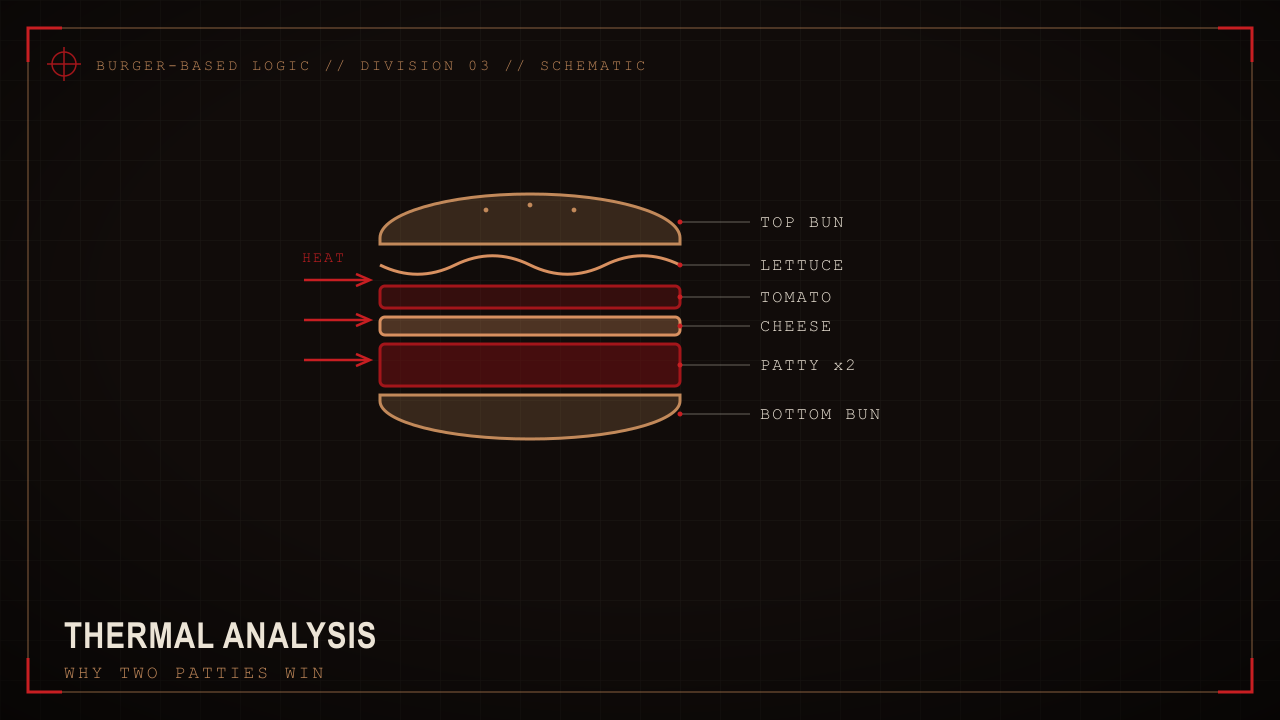
Conduction is heat moving through direct contact — the patty warming the bun it touches, the cold tomato pulling heat out of the cheese against it. Convection is heat carried away by moving air — the steam rising off a fresh patty, taking energy with it into the room. Radiation is heat leaving as infrared, the warmth you feel hovering your hand above the grill. A single-patty burger loses heat through all three channels simultaneously, and because it is thin, it has very little stored energy to lose before it surrenders to room temperature. Thinness is the enemy of warmth, and a single patty is, definitionally, thin.
The Tyranny of Surface-Area-to-Volume
The master variable governing how fast anything loses heat is its ratio of surface area to volume. A small or thin object has a large surface relative to its mass, so it sheds heat fast — this is why a child gets cold faster than an adult, why diced potatoes cook quicker than a whole one, and why a single thin patty goes lukewarm while a thick one stays hot. The double stack attacks this ratio directly. By stacking two patties, you increase the total volume of hot meat while hiding an entire internal face from the cold, lowering the effective surface-area-to-volume ratio of the heated core. Less exposed surface per unit of stored heat means slower cooling. This is not culinary opinion. It is the same equation that designs building insulation and wetsuits.
The Maillard Dimension
Heat retention is only half the argument; the other half is flavor chemistry, and here too the double stack wins on the numbers. The deep, savory, roasted flavor of a good burger comes from the Maillard reaction — a cascade of chemical reactions between amino acids and sugars that occurs on the meat's surface at high temperature, producing hundreds of new aroma and flavor compounds. The crust is where the flavor lives.
Now count the crusted surfaces. A single patty offers two seared faces. Two thinner patties, smashed and seared, offer four seared faces for the same total mass of meat. More Maillard surface per bite means more flavor compounds per bite. This is the entire principle behind the smash burger: thin patties pressed hard onto a screaming-hot griddle to maximize crust. The double smash stack is not merely two patties — it is double the flavor-bearing crust, delivered in the same footprint. The math of deliciousness favors more, thinner, better-seared patties, and the double stack is the natural expression of that math.
One thick patty is mostly interior — soft, gray, under-flavored meat wrapped in a thin shell of the good stuff. Two thin patties are nearly all shell. You are not choosing more meat. You are choosing a higher ratio of the part that tastes like something.
The Cheese Layer: A Functional Component, Examined
We argued before that cheese between two patties is a thermal regulator; let's now give that claim the full engineering treatment it deserves, because the molten interior layer of a double cheeseburger is doing more structural and thermal work than any other element in the build. Processed American cheese is engineered — with emulsifying salts like sodium citrate — to melt into a smooth, stable, flowing liquid rather than splitting into a greasy puddle the way many aged natural cheeses do.
Sandwiched between two hot patties, this cheese performs four simultaneous functions. It fills the air gaps between the irregular patty surfaces, eliminating insulating pockets of air that would otherwise create cold spots. It bonds the two patties into a single structural slab, so the stack behaves as one unit under the shear forces of a bite rather than sliding apart. It contributes a phase-change buffer — energy absorbed in melting and released in cooling smooths the temperature curve of the core. And it carries fat-soluble flavor compounds across the whole interface. One slice. Four jobs. The fast-food engineers who standardized this did the physics, even if they never wrote it down.
Reliability Engineering: The Redundancy Argument in Full
Now the case from a discipline that has nothing to do with food and everything to do with why the double stack is superior: reliability engineering, the science of building systems that don't fail catastrophically when one component does. A single-patty burger is a system with no redundancy. The patty is a single point of failure, and single points of failure are exactly what reliability engineers spend their careers eliminating from aircraft, power grids, and spacecraft.
If your one patty is overcooked, the burger is overcooked — total system failure from a single fault. The double stack introduces true redundancy. Two patties of slightly different doneness average across the bite; a patty that came off a touch dry is rescued by its partner that came off juicy. Engineers call the ideal behavior 'graceful degradation' — a system that tolerates a fault in one component by absorbing it across the whole, declining in quality gradually rather than failing all at once. The double stack is graceful degradation rendered in beef. One patty can disappoint. Two patties have to conspire to fail, and conspiracies, as this publication knows, are harder to pull off than people think.
The Independent-Failure Principle
There is a subtle statistical point that strengthens this. The cooking outcomes of two patties are largely independent events — the flaws in one are uncorrelated with the flaws in the other. When you average two independent samples, the variance of the average is lower than the variance of either alone. In plain terms: the double stack is not just more forgiving on average, it is more consistent, bite to bite, because random cooking errors partially cancel out. The single patty gives you whatever it gives you. The double stack regresses toward the reliable mean. That is the same principle that makes a diversified portfolio steadier than a single stock, applied to dinner.
Addressing Every Objection
A rigorous case answers its critics, so let's take the objections in turn and dispose of them, because each one, examined, actually reinforces the thesis. The bun-ratio objection — that two patties overwhelm the bread — is real but misdiagnosed: the fault lies in a bun not scaled to the build, not in the second patty. Match the bun to the stack and the objection vanishes. You don't remove an engine cylinder to fix a chassis.
The 'it's too much' objection confuses quantity with structure; the double stack's advantages in heat retention, crust ratio, and reliability hold regardless of overall size, and a smash-style double can weigh less than one thick single while outperforming it on every metric we've discussed. The 'I prefer the meatiness of one thick patty' objection is a preference for interior texture, which is legitimate but is a vote for less Maillard crust and more under-flavored gray center — a choice you are free to make, the way you are free to prefer a less efficient engine for the sound of it. Preference is sovereign. The physics is not up for a vote.
The Verdict, Expanded
The double stack is not indulgence, and it is not merely 'more.' It is a comprehensively superior engineering solution: it retains heat longer by lowering the surface-area-to-volume ratio of its core, it delivers more flavor by maximizing seared Maillard surface, it uses its cheese as a four-function structural and thermal component rather than a garnish, and it tolerates cooking error through genuine, statistically grounded redundancy. Every one of those advantages is measurable, and every one favors two patties over one.
So the next time someone orders a single patty in your presence, understand the full scope of what they have chosen: a thermally inefficient, flavor-poor, single-point-of-failure food system, selected over a demonstrably superior alternative sitting one line up on the same menu. You need not say a word. Burger-based logic has never required you to win the argument out loud. It requires only that you have run the numbers, eaten the evidence, and reached the conclusion the physics was always going to force. Question everything. Especially the single patty.
Kai Doss
Field Analyst
Laid-back by nature, dangerous when focused. Kai has an uncanny ability to find the thread that connects a 1970s government memo to a fast-food mascot. Nobody knows how. He claims it's intuition.
Connected Threads
More from Burger-Based Logic
Burger Ingredient Order Is Not Random: The Structural Science of the Stack
Top bun. Sauce. Lettuce. Tomato. Cheese. Patty. Bottom bun. This is not a suggestion. Every element of this sequence has a structural, thermal, or flavour-based justification. Deviate and your burger falls apart. Literally.
Ketchup Is a Monopoly and Mustard Is Anarchy: A Condiment Game Theory
Heinz controls 60% of the American ketchup market. Mustard exists in over 100 varieties with no dominant player. This is not a coincidence. Ketchup is a monopoly. Mustard is anarchic. And the reason tells you something important about how markets actually work.