The Disaster the Soviet Union Hid for 29 Years: The Nedelin Catastrophe
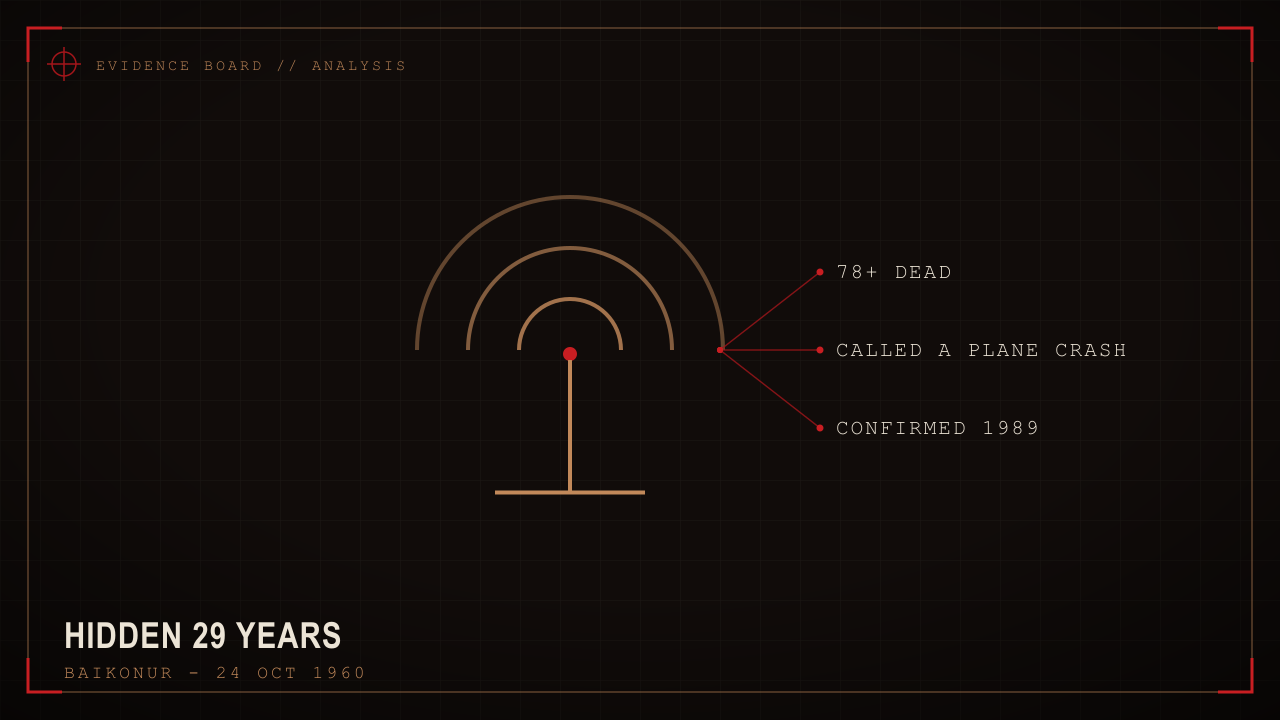
On October 24, 1960, a Soviet R-16 missile exploded on the launchpad during fueling. At least 78 people died, including the commander of the Soviet Strategic Rocket Forces. The USSR denied it happened until 1989.
On October 24, 1960, at the Baikonur Cosmodrome in what is now Kazakhstan, a Soviet R-16 intercontinental ballistic missile exploded during a fueling procedure. The explosion and the firestorm that followed killed somewhere between 78 and 126 people — the exact count has never been fully confirmed — including Marshal Mitrofan Nedelin, the commander of the Soviet Strategic Rocket Forces, who was sitting in a chair on the pad, too close to the rocket, when it ignited.

The Soviet Union did not acknowledge that any of this happened until 1989. For 29 years, the deadliest accident in the history of rocketry was officially a non-event — a thing that, as far as the state was concerned, simply had not occurred. This is a story about a disaster. But it is really a story about how a state erases one.
The Pressure That Built the Bomb
To understand why dozens of people died on that pad, you have to understand the calendar pinned to the wall above them. The R-16 was the Soviet Union's answer to a strategic problem: its existing intercontinental missile used cryogenic fuel that took hours to load and could not be stored ready-to-launch, making it nearly useless as a deterrent. The R-16 used storable hypergolic propellants — fuel and oxidiser that ignite on contact with each other — which made it militarily viable and chemically vicious.
And it was running late. Nikita Khrushchev wanted a successful test to brandish, and the symbolic deadline was the anniversary of the October Revolution in early November. The engineers were behind. The political pressure to launch on schedule, applied from the very top and transmitted down through Nedelin, overrode the engineering caution that the situation screamed for. This is the recurring structure of nearly every great technological disaster: a hard deadline, a soft safety culture, and a powerful man who does not want to hear the word 'wait.'
How It Happened
On the day of the test, the fully fuelled rocket — loaded with tonnes of hypergolic propellant, which is to say loaded with a chemical accident waiting for an excuse — developed a series of faults during the final countdown. Rather than draining the dangerous fuel and standing the rocket down, which would have meant further delay, the decision was made to fix the problems with the missile fuelled and live on the pad. Technicians swarmed the rocket. Safety protocols that would have cleared the area were waived in the interest of speed.
Roughly thirty minutes before the scheduled launch, the second stage engine ignited without command. The flame from the second stage burned directly down into the full fuel tanks of the first stage beneath it. The rocket did not so much explode as become a single, expanding wall of fire across the pad. Many of those killed were not struck by debris — they were caught in the open by a flame front with nowhere to run, on a concrete apron designed to hold a rocket, not to shelter a crowd.
The Death of Nedelin
Marshal Nedelin had positioned himself in a chair near the base of the rocket, in the open, as a deliberate gesture. The message to the nervous technicians was meant to be one of confidence: if the commander himself sits here, the rocket is safe, so get on with it. It was a way of using his own body to apply pressure. When the second stage fired, he was at the centre of the fireball. The identification of his remains was reportedly possible only by the melted remnants of personal effects — a detail that tells you everything about the temperature on that pad.
The Cover-Up Mechanics
Nedelin's death was the immediate logistical problem, because a Marshal of the Soviet Union cannot simply vanish without explanation. The state's solution was a lie issued at the highest level: Nedelin had died in an aviation accident, a plane crash, a clean and unremarkable death befitting a war hero. The dozens of other dead — engineers, technicians, officers — were not publicly named, not collectively mourned, not officially counted. Their families were, in many cases, told to say nothing.
Personnel at Baikonur signed nondisclosure undertakings. The investigation that followed was real, thorough, and entirely internal — the Soviet system was perfectly capable of learning hard engineering lessons in secret while denying to the outside world that there had been anything to learn from. The redesigned procedures saved lives later. The public was simply not permitted to know what they had been bought with.
The space race was a competition conducted partly through propaganda, partly through silence, and occasionally through the deliberate erasure of catastrophes that would have made the other side look human.
The Other Disasters They Hid
The Nedelin catastrophe is the most dramatic example, but it was not the only Soviet space-program death buried by the state, and one of the others carries a consequence that reached all the way into an American spacecraft. In 1961, a young cosmonaut trainee named Valentin Bondarenko died after a fire broke out in a high-oxygen pressure chamber during an isolation exercise; in an oxygen-rich atmosphere, a small flame becomes an inferno almost instantly. His death was concealed until 1986, and his image was even airbrushed out of cosmonaut group photographs — a person edited out of the record like a typo.
The significance reaches beyond the tragedy. The hazard that killed Bondarenko — fire in a pure-oxygen environment — was precisely the hazard that killed the Apollo 1 crew, Grissom, White, and Chaffee, on a launch pad in 1967. Whether earlier knowledge of the Bondarenko fire would have changed NASA's choices is a question that can't be answered cleanly, but it crystallises the real cost of state secrecy: a lesson paid for in one country's blood, classified, and therefore unavailable to save lives in another.
What This Tells Us
Every great national achievement contains disasters paid for in blood and then made invisible, and the Soviet system was structurally, almost artistically, excellent at the making-invisible part. The triumphs — Sputnik, Gagarin, the long parade of firsts — were broadcast to the world. The catastrophes that ran alongside them, the cost of moving that fast under that much political pressure, were sealed in archives and denied to grieving families for a generation.
The Names Came Back
The Nedelin catastrophe was finally confirmed in 1989, as the Soviet Union loosened and then began to come apart, and the archives gave up secrets they had held since before the Cuban Missile Crisis. Nedelin eventually received honest acknowledgement and a monument at Baikonur. The other dead, slowly, got their names attached to the way they had actually died, almost three decades after the state took those deaths and rewrote them into plane crashes and silence.
The lesson files cleanly under 'trust no 1.' A sufficiently powerful institution can delete an event involving more than a hundred people for twenty-nine years, and very nearly forever. The fact that we know about Nedelin at all is not a triumph of investigation. It is an accident of a collapsing empire that stopped guarding its filing cabinets. Question everything — and ask, always, what is still in the cabinets that have not yet been left unlocked.
The Secret Architecture of the Soviet Space Program
To understand how a disaster killing more than a hundred people could vanish for twenty-nine years, you have to understand that the entire Soviet space program was, structurally, a secret — not just its failures but its successes, its locations, its leaders, and the names of the men who built it. Secrecy was not a response to disaster. It was the operating system.
Consider the most extraordinary example: the man who designed the rockets that launched Sputnik and Yuri Gagarin, the founding genius of the Soviet space effort, was known publicly only as 'the Chief Designer.' His actual name — Sergei Korolev — was a state secret for his entire career, withheld even when his achievements made the Soviet Union the envy of the world, partly out of fear that the West would assassinate him. He had survived the Gulag in the 1930s, arrested and tortured in Stalin's purges, his jaw broken, sent to a labor camp, and later transferred to a prison design bureau where imprisoned engineers built weapons for the state that had imprisoned them. The architect of Soviet space triumph was an anonymous former prisoner. That is the system we are dealing with.
A Closed City That Did Not Officially Exist
The launch site itself was a fiction within a fiction. Baikonur Cosmodrome was deliberately named after a town that sat hundreds of kilometers from the actual facility, a calculated misdirection to confuse Western intelligence about its true location. The real site, and the closed city of Leninsk that supported it, did not appear honestly on maps. Tens of thousands of people lived and worked at a place the state preferred the world not to locate precisely. When your launch site is itself a deception, hiding a launch-pad disaster is merely an extension of standing policy.
The R-16: A Rocket Built Under a Political Gun
The specific machine that killed Marshal Nedelin and his men was the product of a strategic anxiety and a personal rivalry, and both pressures bore directly on the decisions that turned a malfunction into a massacre. The Soviet Union's existing intercontinental missile, Korolev's R-7, was a magnificent space launcher but a poor weapon: it used cryogenic liquid oxygen that boiled away and could not be stored, meaning the missile took hours to fuel and could not sit ready to launch. As a deterrent, a weapon that needs half a day's warning is nearly useless.
The R-16, designed by Korolev's rival Mikhail Yangel, solved this with storable hypergolic propellants — fuel and oxidizer that ignite instantly on contact with each other and can be loaded and held ready. This made the R-16 a genuine weapon. It also made it a chemical death trap, because hypergolic propellants are savagely toxic and need only a single failure of separation to ignite spontaneously. The very property that made the rocket strategically valuable — fuel that ignites on contact — is precisely what made the pad disaster instantaneous and total.
The Anatomy of the Catastrophe
Let's walk the final hours with the precision the dead are owed, because the disaster was not bad luck. It was the predictable output of a deadline overriding a safety culture, the same structure that produces nearly every great technological catastrophe. The test had already slipped, and the symbolic deadline of the Revolution anniversary in early November loomed. Khrushchev wanted a triumph to brandish. The pressure flowed down the chain to Nedelin, and from Nedelin onto the engineers.
On the pad, fully fueled with tons of hypergolic propellant, the rocket developed faults during the countdown — problems with the guidance system and the pyrotechnic devices that controlled stage separation. The correct, safe procedure was to drain the dangerous propellant and stand the rocket down for repairs, which meant days of further delay. Instead, the decision was made to fix the faults with the rocket fueled and live. Technicians by the dozen swarmed the missile. The blockhouse safety rules that should have cleared all personnel were waived in the name of speed. Roughly thirty minutes before launch, an electrical command sequence fired the second stage engine while it still sat atop the full first stage.
Thirty Seconds of Fire
The second stage ignited downward into the first stage's fuel tanks. The rupture released the full propellant load, fuel and oxidizer meeting in the open air, and the pad became a single expanding sphere of flame perhaps a hundred meters across. Most of those killed were not struck by debris. They were caught in the open, on a concrete apron with nowhere to run, by a fireball that consumed the oxygen and incinerated everything within reach. Security footage from automatic cameras, kept rolling to document the test, instead documented the deaths — figures running, some melting into the burning tarmac, the perimeter fence trapping those who tried to flee.
Marshal Nedelin had placed his chair near the base of the rocket, in the open, as a deliberate gesture of confidence meant to shame the nervous engineers into proceeding. He was at the center of the fireball. His remains were reportedly identifiable only by a melted medal and the metal of his keys. The chief designer, Yangel, survived only because he had stepped away to a bunker to smoke a cigarette — a nicotine habit that, by pure chance, removed him from the kill zone in the final minutes.
The deadline did not bend the rocket. It bent the people around the rocket, until they agreed to do the one thing every rule forbade — and the rocket, indifferent to politics, did exactly what fueled rockets do when you make a mistake while standing next to them.
The Machinery of Erasure
The cover-up that followed was not improvised. It was the routine application of a state apparatus built for exactly this, and its smoothness is more chilling than any clumsy lie would be. The immediate problem was Nedelin: a Marshal of the Soviet Union does not simply disappear. The solution was issued from the top — Nedelin had died in an aviation accident, a clean and honorable death for a war hero. No fireball. No pad. A plane crash.
The other dead — engineers, officers, technicians, in numbers somewhere between 78 and 126 — were largely not named publicly, not collectively mourned, not officially counted. Survivors and witnesses signed undertakings of silence. Families were given fabricated or vague causes of death and instructed not to discuss them. The internal investigation, by contrast, was real, rigorous, and unflinching — the Soviet system was entirely capable of learning hard engineering lessons in secret while denying to the world that there had been anything to learn. The redesigned procedures that emerged saved lives in later launches. The public was simply forbidden to know the price.
A Pattern, Not an Exception
Nedelin was the largest concealed disaster, but it was one node in a network of erasures, and seeing the pattern is what reveals it as policy rather than accident. The death of the cosmonaut trainee Valentin Bondarenko in a 1961 pressure-chamber fire was hidden until 1986, and his image was airbrushed from group photographs — a person edited out of the record. Rumors of 'lost cosmonauts,' supposedly killed in secret failed flights, circulated for decades; most are unsubstantiated, and an honest investigator separates the documented Bondarenko from the speculative phantoms, but the very plausibility of the rumors testifies to how thoroughly the program had earned its reputation for deletion.
The Bondarenko case carries the heaviest consequence. The hazard that killed him — fire in a pure-oxygen atmosphere, where a spark becomes an inferno — was the identical hazard that killed the Apollo 1 crew in 1967. Whether earlier disclosure would have changed NASA's choices cannot be known with certainty, and we should not pretend otherwise. But it crystallizes the true cost of state secrecy: a lethal lesson, paid for in one nation's blood, sealed in an archive, and therefore unavailable to save lives in another. Secrets do not just hide the past. They withhold the future's warnings.
Why It Surfaced — And Why That's Not Reassuring
The Nedelin catastrophe was finally confirmed in 1989, in the glasnost twilight of the Soviet Union, when the archives loosened and the state lost the will, or the ability, to keep guarding its filing cabinets. Nedelin eventually received honest acknowledgment and a monument at Baikonur. The other dead slowly had the truth of their deaths restored, almost three decades late.
But notice what actually broke the secret. It was not investigative journalism, not a heroic leak, not the system being held to account. It was the collapse of the regime itself — an accident of history that happened to leave the archives unguarded. The disaster stayed buried for as long as the state that buried it remained strong, and surfaced only when that state began to die. That is the genuinely sobering lesson. A sufficiently powerful institution can delete an event involving more than a hundred deaths for twenty-nine years, and the only reason we know about this one is that the institution fell. Question everything — and ask, always, what is still sealed in the cabinets of the regimes that have not yet collapsed. Trust no 1, least of all the official cause of death.
Marcus Veil
Lead Investigator
Suited, skeptical, and allergic to anything that hasn't been cross-referenced at least twice. Marcus spent a decade in investigative journalism before concluding that the real story is almost always the one they didn't file.
Connected Threads
More from Weird Facts
Oxford University Is Older Than the Aztec Empire (And That Should Bother You)
Teaching at Oxford began around 1096. The Aztec capital of Tenochtitlán was founded in 1325. The institution we still use today predates an entire empire that Europeans described as ancient when they arrived to destroy it.
The Mechanical Turk: The 18th-Century Chess Robot That Was a Man in a Box
In 1770, Wolfgang von Kempelen unveiled a chess-playing automaton that beat Napoleon Bonaparte, Benjamin Franklin, and the Prince of Prussia. It was draped in robes, sat behind a wooden cabinet, and was operated by a human hiding inside. The deception lasted 84 years.