Oxford University Is Older Than the Aztec Empire (And That Should Bother You)
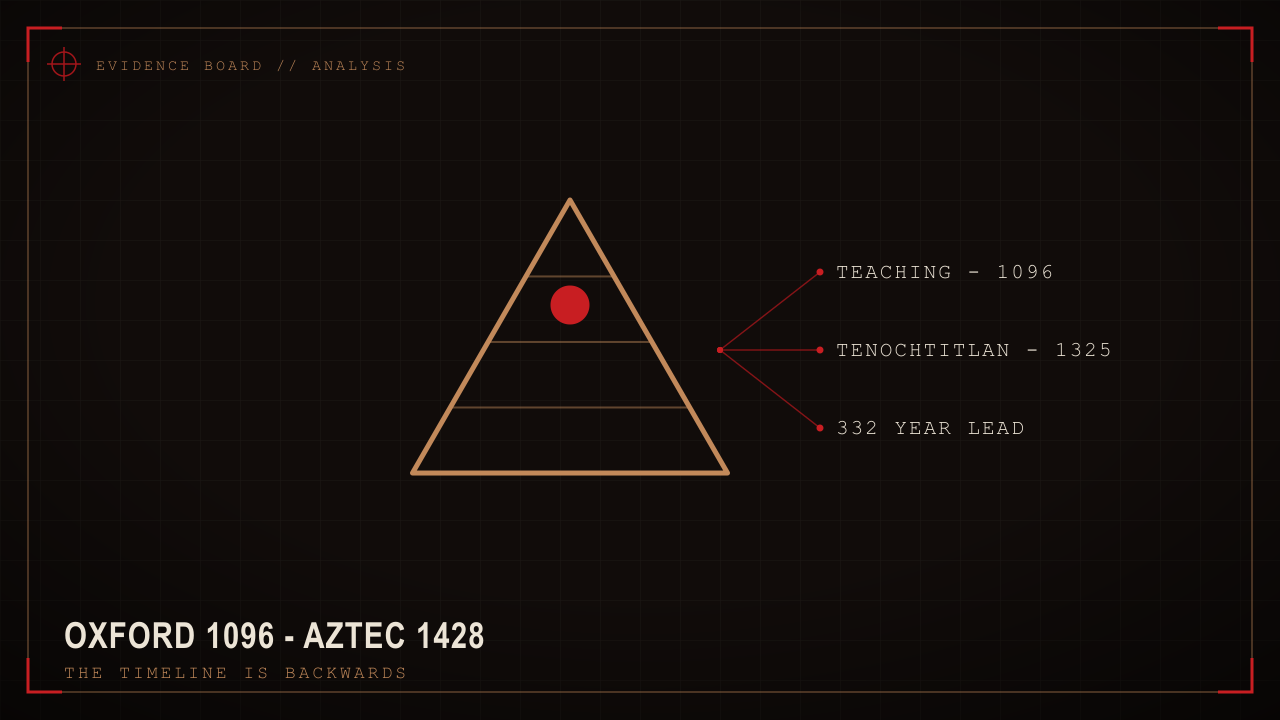
Teaching at Oxford began around 1096. The Aztec capital of Tenochtitlán was founded in 1325. The institution we still use today predates an entire empire that Europeans described as ancient when they arrived to destroy it.
Teaching began at Oxford around 1096. The Aztec capital of Tenochtitlán was founded in 1325. This means that when Hernán Cortés arrived in Mexico in 1519 and described the Aztec Empire as an ancient and sophisticated civilisation, Oxford University had already been operating, teaching, and granting degrees for over 400 years. Let that sit for a second. Then let it bother you, because it should.
The Timeline Problem
We carry a mental map of history that places European institutions in the 'new' column and pre-Columbian civilisations in the 'old' column — the Old World meeting the New World, antiquity meeting modernity. This is, in certain specific cases, almost exactly backwards. The University of Oxford predates not just the Aztec Empire but the founding of the city that would become its capital.
The Aztec Triple Alliance — the political structure Europeans actually encountered and called 'the empire' — wasn't forged until 1428. By that point Oxford had been producing graduates for over three centuries. It had survived a royal ban, a temporary relocation, riots between students and townsfolk, and the founding of its great rival at Cambridge. It was, by the standards of any institution, already old when the Aztec empire was brand new.
Why Our Sense of Time Is Broken
The culprit is a cognitive bias so common it barely has edges: we compress the past. Everything beyond living memory tends to collapse into a single undifferentiated 'long ago,' as though the pyramids, the Roman legions, the samurai, and the Founding Fathers all milled around in the same misty antechamber of history. They did not. The distances between them are vast, and our refusal to feel those distances produces genuinely false intuitions about what came before what.
The old world was sometimes newer than the new world. History does not arrange itself for your convenience, and it is under no obligation to match the order in which you happened to learn about things.
More Comparisons That Break Your Brain
Once you start pulling this thread, it doesn't stop. The University of Bologna, generally considered the world's first university, was founded in 1088 — making it older than essentially every empire most people think of as 'medieval.' Cambridge was founded in 1209. Both predate the Mongol Empire at its full territorial extent, which peaked in the 1200s and 1300s.
Keep going. The Magna Carta was sealed in 1215, which makes it older than the Renaissance. The Renaissance, in turn, was already underway before the potato arrived in Europe from the Americas. Anne Frank and Martin Luther King Jr. were born in the same year. The last execution by guillotine in France happened the same year the first Star Wars film was released. Time refuses to line up the way your gut insists it should.
The Aztec Empire Was Younger Than Notre-Dame
Here's the one that does the most damage. Construction on Notre-Dame de Paris began in 1163. The Aztec Empire — the Triple Alliance — was founded in 1428. The cathedral was already over 250 years old, already weathered and sooted and patched, by the time the empire Cortés would describe as ancient even existed. The Inca Empire, founded around 1438, is younger than the Black Death that swept Europe in the 1340s. The civilisations Europeans cast as timeless and primordial were, in raw chronological fact, often startlingly recent.
Why This Matters Beyond the Trivia
It would be easy to file all this under 'fun facts to win an argument,' but there's something heavier underneath. The mental compression of history had consequences. When Europeans described the societies of the Americas as 'ancient civilisations,' the word ancient did political work. It framed those peoples as relics — frozen, timeless, outside of history — rather than as dynamic, recently expanded, still-evolving states with their own current events, factional politics, and unfinished projects.
A civilisation you imagine as ancient is a civilisation you imagine as already finished, already on its way out, naturally yielding to whatever comes next. The chronology — Oxford older than the empire — punctures that frame entirely. These were not dusty remnants. They were going concerns, younger than the cathedral the conquistadors had prayed in as children.
The Part That Should Actually Bother You
And now the kicker, the one that turns a piece of trivia into a small existential event. Oxford University is still operating. In almost exactly the same location. Using, in some colleges, the same buildings, the same quadrangles, the same dining halls where students ate eight centuries ago. It has outlasted the Aztec Empire, the Inca Empire, the Byzantine Empire, the Mongol Empire, the Ottoman Empire, the Spanish Empire that destroyed Tenochtitlán, and the British Empire that once spanned a quarter of the planet. It survived the Black Death, the Reformation, the Civil War, and two World Wars.
Whatever you built today — the company, the app, the careful little life — will almost certainly not be standing in the year 2900. Empires that ruled millions are gone without a fluent living speaker of their language. And a university in the south of England, which started informally because some scholars couldn't get to Paris, just keeps opening for the next term. Question your sense of what is permanent. It is almost certainly wrong, and almost certainly in the opposite direction from what you'd guess.
How Oxford Actually Began
The claim that Oxford predates the Aztec Empire rests on a date — around 1096 — that deserves unpacking, because the origin of the university is itself a lesson in how institutions accrete rather than launch. There was no founding moment, no charter signed, no ribbon cut. Oxford did not open. It congealed.
Teaching existed in the town from at least 1096, but the institution crystallized through an accident of geopolitics. In 1167, amid a quarrel between the English king Henry II and the French crown, English scholars were effectively recalled or barred from the University of Paris, then the intellectual center of Europe. They needed somewhere to go, and they converged on Oxford, an existing town of teaching with good road connections and royal proximity. The expelled scholars of Paris are, in a real sense, the seed crystal of Oxford. The university was born from a diplomatic spat and a forced migration of academics.
The Riot That Made the Colleges
The college system — the thing that makes Oxford recognizably Oxford — emerged partly from violence. In 1209, after townsfolk hanged two scholars in retaliation for a death, the scholarly community scattered in fear, some fleeing to Cambridge, founding that university in the process. To protect students from the lethal hostility of the town, halls and colleges were established as walled, self-governing communities where scholars could live and study under their own authority. The quadrangle, that serene architectural symbol of learning, has its origins in the need for academics to be safe from the people who lived next door.
Meanwhile, in the Valley of Mexico
To make the comparison fair, we should give the Aztec side its full due, because the point is not that Oxford was sophisticated and the Aztecs were not — it is that both were dynamic, recent, evolving things, and our intuition wrongly freezes one as 'modern' and the other as 'ancient.' The Mexica, the people we call the Aztecs, were latecomers to the Valley of Mexico, migrants who arrived to find the good land already taken and were forced onto a marshy island in Lake Texcoco.
On that island, beginning around 1325, they built Tenochtitlan, and what they built was staggering. By the time the Spanish arrived in 1519, it was one of the largest cities in the world, larger than any city in Spain, threaded with canals, fed by engineered causeways and aqueducts, and supported by chinampas — the famous 'floating gardens' of incredibly productive reclaimed farmland. The conquistadors, men from the grimy, plague-prone cities of early-modern Europe, recorded their genuine astonishment at its scale, cleanliness, and order. One wrote that the soldiers wondered whether the vision before them was real or a dream.
Younger Than the University Library
Now hold the two timelines together. When Tenochtitlan was founded around 1325, Oxford had been teaching for over two centuries and Cambridge for more than a hundred years. The Aztec Triple Alliance — the actual empire — was not forged until 1428, by which point the universities of England were mature institutions with established colleges, libraries, and traditions. The empire that Cortes would describe as ancient was, in hard chronological fact, younger than Merton College. The 'New World' empire postdated the 'Old World' university by a comfortable margin.
A Tour of Broken Intuitions
Once you accept that your sense of historical sequence is unreliable, a whole gallery of disorienting facts opens up, and each one is a small hammer-blow to the false intuition that 'old things all happened together.' Let's walk the gallery.
Cleopatra lived closer in time to the first Moon landing than to the construction of the Great Pyramid of Giza. The pyramid was already more ancient to her than she is to us. The woolly mammoth was not a creature of some unimaginably distant epoch — a small population survived on Wrangel Island in the Arctic until around 4,000 years ago, meaning mammoths still walked the Earth while the Egyptians were building pyramids and the first written epics were being composed.
The fax machine was patented in the 1840s, before the American Civil War — the technology predates the telephone. Spain was still, technically, at war with the Berber states in arrangements that lingered absurdly long; the University of Oxford predates the Aztec capital; and Harvard University, founded in 1636, is older than calculus, older than Newton's 'Principia,' and was admitting students before the existence of the integral sign that its mathematics students would later learn.
History is not a tidy procession from old to new. It is a pile, dropped on the floor, and our minds impose an order on it that the actual dates cheerfully refuse to obey.
Why the Compression Happens
There is a real cognitive mechanism behind all this disorientation, and naming it helps inoculate against it. Psychologists describe a logarithmic sense of time: we perceive durations in the deep past as compressed, the way distant objects appear bunched together on the horizon. Everything beyond living memory tends to flatten into a single undifferentiated 'long ago,' so the pharaohs, the legions, the knights, and the founding fathers all seem to mill about in the same misty room.
This is reinforced by how history is taught — in thematic units rather than a single continuous timeline. We learn 'Ancient Egypt' as a block, 'the Aztecs' as a block, 'medieval Europe' as a block, and we rarely lay the blocks end to end on a single ruler to feel the true gaps and overlaps between them. The result is a population of educated people who know thousands of historical facts and have almost no reliable feel for what was simultaneous with what.
The Stakes Beyond Trivia
It would be easy to treat all this as pub ammunition, but the compression of history did real damage, and naming that damage is the serious core beneath the fun. When Europeans cast the civilizations of the Americas as 'ancient,' the word was not neutral. To call a living society ancient is to call it finished — frozen, timeless, already belonging to the past, naturally yielding to whatever comes next. It is a framing that quietly justifies conquest by casting the conquered as relics rather than rivals.
The chronology punctures that frame entirely. The Aztec and Inca empires were not dusty survivors of a vanished age. They were young, expanding, recently consolidated states with current politics, factional rivalries, ongoing reforms, and unfinished ambitions — going concerns, in many cases younger than the European cathedrals the conquistadors had been baptized in. They were not the past meeting the present. They were one present meeting another, and the violence that followed was not the future overtaking the past but simply one young, aggressive power destroying another.
The Part That Should Still Bother You
And now the conclusion that turns trivia into something closer to vertigo. Oxford is still open. Not as a ruin, not as a museum, but as a working university, teaching this term, in some colleges within the same stone walls and dining halls that sheltered scholars eight centuries ago. It has outlived the Aztec Empire, the Inca Empire, the Byzantine Empire, the Mongol Empire, the Ottoman Empire, the Spanish Empire that erased Tenochtitlan, and the British Empire that once painted a quarter of the globe its color. It survived the Black Death, the Reformation, the English Civil War, and two World Wars, and it simply opened again for the next term each time.
Whatever you built today — the company, the app, the carefully assembled little life — will almost certainly be gone by the year 2900. Empires that commanded millions have vanished so completely that no one alive speaks their language. And a university that began because some scholars got thrown out of Paris and needed somewhere to teach just keeps unlocking its doors every autumn, indifferent, persistent, and far older than the 'ancient' empires we were taught to imagine as the deep past. Question your sense of what endures. It is almost certainly wrong, and almost certainly backwards.
Kai Doss
Field Analyst
Laid-back by nature, dangerous when focused. Kai has an uncanny ability to find the thread that connects a 1970s government memo to a fast-food mascot. Nobody knows how. He claims it's intuition.
Connected Threads
More from Weird Facts
The Disaster the Soviet Union Hid for 29 Years: The Nedelin Catastrophe
On October 24, 1960, a Soviet R-16 missile exploded on the launchpad during fueling. At least 78 people died, including the commander of the Soviet Strategic Rocket Forces. The USSR denied it happened until 1989.
The Mechanical Turk: The 18th-Century Chess Robot That Was a Man in a Box
In 1770, Wolfgang von Kempelen unveiled a chess-playing automaton that beat Napoleon Bonaparte, Benjamin Franklin, and the Prince of Prussia. It was draped in robes, sat behind a wooden cabinet, and was operated by a human hiding inside. The deception lasted 84 years.